
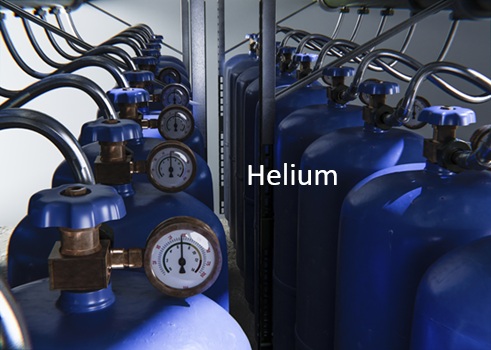
Helium, denoted by chemical symbol He, is the coolest element with a boiling point of -269℃. It is an inert gas, lighter than air and is not inflammable, i.e. it does not burn. These properties of He make it one of the most interesting elements with numerous critical applications. In this blog article, I discuss how these properties of He are useful in the applications they are used for. Further, I also present the promises this element holds for in solving critical issues that we are facing at present. I try not to delve too much into scientific aspects and thereby make this article comprehensible for all readers regardless of their background in Science.
Genesis of Helium
Helium is the second most abundant element in the universe next to hydrogen. However, it is rare on earth. This is due to the fact that it is lighter than air and it can escape easily from the earth’s atmosphere. The genesis of this element is intriguing not only from a chemical perspective but also from a philosophical angle about the creator and creation. Helium originates from the core of the sun and is believed to be the second element formed in the universe just after the creation of the universe.
The big bang theory, the steady state theory and other theories which postulate about the creation of the universe state that the universe initially consisted of dense matter made up of neutrons (represented as 0n1). These neutrons at very high temperatures of the order of millions of ℃ exploded forming protons (represented as1p1), electrons (represented as -1e0) and high energy particles called neutrinos.
0n1 -> 1p1 + -1e0 + 𝒗
The protons then fused to form hydrogen. Hydrogen atoms fused further to form Helium. As these involved the nucleus of the atom, they were nuclear reactions. Since they involved fusion (joining), these were nuclear fusion reactions.
Protons are positively charged particles and when they come closer together they experience enormous repulsion. High energy is needed for these particles to overcome the repulsive forces arising from similar charges and to come closer together. These high energies are derived from high temperatures of the order of millions ℃. Such high temperatures occurred only in the core of the sun. The nuclear reactions of formation of Helium from Hydrogen can be represented as:
1H1 + 0n1 -> 1H2 + energy
1H2 + 1H1 -> 2He3 + energy
2He3 + 0n1 -> 2He4 + energy
2He4 + 0n1 -> 2He5 + energy
2He5 had a very short life of the order of only nanoseconds or even lesser. Hence they disappeared effectively stopping the fusion reactions. Further, as temperatures came down, these fusion reactions did not occur and the initial formation of the universe stopped.
From these reactions, the core of the sun consisted more of the coolest element 2He4 causing the core to expand to the extent that they exploded to form other massive dense particles thereby creating galaxies consisting of several stars. These reactions produced enormous energies such that the entire universe was created. Theoretically, it is estimated that fusion of four atoms of hydrogen giving a helium atom generates energy of the order 25MeV (Million electron Volt).
The creation involved quadrillions and quadrillions of atoms of hydrogen and it is left to our imagination to estimate how much of atoms would have got fused and how much energy would have been evolved. Millions of 25MeV energy generated can be compared to the energy generated from a standard AA battery. Studies show that as the universe is expanding, hydrogen is getting generated continuously to fill the gaps in the universe. Hydrogen accounts for 88.6% and Helium for 11.3% of all the atoms in the universe.
Availability of Helium on the earth
Helium exists in plasma form, that is in a gaseous form with neutrons and electrons floating freely in a matrix in the universe. While this is the genesis of He in the universe where it is in abundance, it is not so in the earth. It is just not possible to create that high magnitude of temperature in the earth to form Helium. However, it is found trapped inside natural gas methane in the earth. Helium is extracted from natural gas and is stored in cylinders.
The abundance of Helium in the atmosphere is only about 5ppm by volume and recovery from air is very expensive. Helium is trapped underground in natural gas. The richest source is in the southwest USA, where the natural gas contains 0.5-0.8% He. This provides most of the world’s supply of He. Other natural gas deposits containing appreciable amounts of He have been found in Algeria, Poland, Russia and Canada.
Unique properties of Helium
Helium is a colorless, odorless gas. It is a unique element.
- It has the lowest boiling point of any substance known. Its boiling point is -269℃. To get an idea, compare this with water which boils at 100℃.Its boiling point is so low because it has very weak forces between them, i.e. it has very low interatomic forces.
- It has the lowest boiling point of any substance known. Its boiling point is -269℃. To get an idea, compare this with water which boils at 100℃.Its boiling point is so low because it has very weak forces between them, i.e. it has very low interatomic forces.
- It has zero thermal conductivity which means it transmits no heat. Hence it finds use in cryogenics, i.e. in applications where extreme cooling is required.
- All other elements become solids on cooling, but cooling of He, i.e. bringing the temperature below -269℃, only produces helium liquid. Upon further cooling of helium liquid, it goes into a miraculous superfluid state where it has zero viscosity. Zero viscosity means it has no resistance and it can move freely in any direction (up, down, sidewards).
- It is a small element, is inert (i.e. it does not undergo chemical reaction with any other element), and it does not burn, this property is used to check leaks in situations such as jets and airships where there are rapid increases in temperature.
Applications of Helium
Helium is used in analytical, engineering, lab, science, and specialty gases (22%); controlled atmospheres, fiber optics, and semiconductors (17%); lifting gas (17%); magnetic resonance imaging (15%); aerospace (9%); welding (8%); diving (5%); leak detection (5%); and other applications (2%).
- It’s lighter than air and non-inflammable properties are put to use as a lifting gas where it is used to lift airships and balloons.
- Since it is radioactive, some of its radioactive forms (called isotopes) are used in medical treatment such as in cancer. The isotopes are used to destroy cancerous cells.
- It has an interesting use in MRI scanning applications. MRI machines use massive electromagnets to capture detailed medical images. To conduct electricity without resistance (i.e. superconductivity), the magnet’s wires must be kept incredibly cold. MRI magnets must become superconductive to generate the immensely powerful, stable, and highly uniform magnetic fields required for high-resolution medical imaging. By operating at near-absolute-zero temperatures, superconducting wires lose electrical resistance, allowing massive, heat-free currents to flow continuously and produce crystal-clear images of the body’s soft tissues.
- This is where Helium serves an important purpose – Liquid helium bathes these coils, absorbing heat and lowering electrical resistance to virtually zero. It provides the extreme, stable cooling necessary for the magnet to generate a consistently powerful, distortion-free magnetic field.
- It is used in leak detection such as in airships and jets. It becomes a superfluid with zero viscosity when cooled below -269℃. This form of He can move freely in all directions defying gravity and hence it is used in leak detection.
- An important use of Helium is in manufacturing of semiconductors. Its high thermal conductivity, inertness, and tiny size properties are used for cooling and leak detection during chip manufacturing. Helium is used in reactive ion etching in semiconductor manufacturing. During high-temperature plasma etching and photolithography, it rapidly wicks heat away from delicate silicon wafers to prevent them from warping or sustaining thermal damage.
- Because it is a noble gas, helium does not react with delicate and volatile chip materials. This makes it the ideal carrier and dilution gas for extreme ultraviolet (EUV) lithography and chemical vapor deposition (CVD), ensuring a contamination-free atmosphere.
- Helium has the smallest atomic radius of any element, allowing it to squeeze through microscopic cracks and pores that other gases cannot penetrate. Manufacturers use it to detect vacuum leaks at the 1 part-per-billion level, preserving the ultra-clean, airtight environments required for nanoscale manufacturing.
- The semiconductor sector accounts for roughly a quarter of global helium consumption. Its use is rapidly growing alongside the surge in advanced chip production for AI, quantum computing, and electric vehicles.
Thus, Helium with its unique properties is immensely useful in many critical applications that are essentially guiding the economy of the world in the current times. It is interesting to note that this element which is so abundant in the universe is of low abundance and occurrence in the earth. Extraction techniques such as fractional distillation are used to extract Helium from natural gas and the extracted helium is stored in gas cylinders and transported across places.
Discussion
Helium is formed by nuclear fusion of hydrogen atoms. Helium further undergoes nuclear fusion to form other elements. The complete fusion of the nuclei in 1 pound (0.4kg) of deuterium (isotope of hydrogen) would result in the same energy release as 26,000 tons of TNT. Nature has utilized nuclear reactions to create this universe, and nuclear reactions are taking place forever to sustain this universe. Nature (Creator) could create the required reaction conditions such as high temperatures of the order of millions of degrees Celsius. Further, it is also able to process the enormous energy generated in a controlled and sustainable manner thereby protecting this universe. This is where it may get philosophical too.
Nature has perfected nuclear fusion reactions. However, controlled nuclear fusion reactions have not been achieved yet on the earth. It is just impossible to generate the temperatures (required in millions of degrees Celsius) to carry out a nuclear fusion reaction. Controlled nuclear fission reactions have been achieved to generate electricity, and I have written about nuclear fission reactions with Uranium in a previous blog – About the heaviest naturally occurring element Uranium and its use as a nuclear fuel in electricity generation – Foxtail Research. If at all controlled nuclear fusion reactions can be carried out, it can generate enormous energy that could solve the energy problem for the world. There will be unlimited energy and power in the world.1 The energy yield will be 100 times greater than that from a Uranium fission.
Summary
Helium has and is playing an irreplaceable role in the universe. It is formed from high-temperature nuclear fusion reactions which can occur only in the core of the sun. Helium formation is accompanied by enormous energy generation. The magnitude of energy generated is so high that it could form a whole galaxy of stars. It is a miracle that Helium which is getting formed in the hottest part of the universe is the coolest element ever known and it is absolutely non-inflammable, i.e. it does not burn and is inert. It is used as a coolant for several critical applications that generate enormous heat and need cooling to carry out the processes. Its unique properties such as small size, lighter than air, non-inflammable nature, superfluidity, inertness, high thermal conductivity, and low boiling point are used in detecting leaks, lifting airships, lifting balloons, manufacturing semiconductors, MRIs and other medical applications.
Bibliography
1. Concise Inorganic Chemistry, J.D.Lee, ELBS fifth edition,1996
2. Geological survey: Helium Statistics and Information | U.S. Geological Survey
https://www.usgs.gov/centers/national-minerals-information-center/helium-statistics-and-information
3. Innovative work: The history of helium: Properties, reserves, production and uses https://www.innovationnewsnetwork.com/the-history-of-helium-properties-reserves-production-and-uses/48282/
4. IDTechEx: https://www.idtechex.com/en/research-article/helium-conservation-needed-to-support-a-growing-semiconductor-industry/31674
Image courtesy:<a href=”https://www.magnific.com/free-photo/3d-rendering-gas-cylinder_22896647.htm“>Image by freepik</a>




Leave a Reply