
Uranium with the symbol U is the heaviest naturally occurring element in the earth’s crust. It finds use as a nuclear fuel. Enormous amounts of electricity can be generated from Uranium through nuclear reactions. With the widespread adoption of AI and the need for more data centers, there is a need for more electricity. In this article, I write about the properties of U that make it a nuclear fuel. Further, I present an overview of the process of electricity (power) generation that happens in the nuclear reactors and finally through calculations show the theoretical amount of electricity that can be generated from a kilogram of Uranium ore. I try not to delve too much into scientific aspects and thereby make this article comprehensible for all readers regardless of their background in Science.
Uranium (U) is the heaviest naturally occurring element in the earth’s crust. It has unstable nuclei and undergoes radioactive decay. Even though it undergoes radioactive decay, it is not a rare element and occurs with relatively high abundance in the earth’s crust. U is available in the magnitude of tons in the earth’s crust. This is due to its high half-life period t1/2. Half-life period measure tells the number of years it takes for half of the nuclei to decay and for Uranium which occurs in two forms or as two isotopes U-235 and U-238, is 7.04 x 10⁸ years and 4.5 x 10⁹ years respectively. This high half-life period which is in the order of billions of years tells why this element should have been since the earth was formed and why it is in relatively high abundance in spite of it undergoing radioactive decaying.
U occurs in nature as mineral ores in the form of oxides, i.e. Uranium with oxygen. The most common naturally occurring ore is pitchblend. It occurs as U3O8 or UO2. U is extracted from its ores and is stored as mineral concentrate before it is used in reactions. Economically recoverable Uranium reserves are located in western United States, Australia, Canada, Central Asia, Africa, and South America.
Ever since the discovery of the U fission process in 1938, U has been used as a nuclear power source for generating electricity. The splitting of the U nucleus, i.e. nuclear fission, liberates enormous energy. This fission process was used to create the first man-made nuclear chain reaction in 1942. Here, I explain briefly what makes U a nuclear fuel and compare the magnitude of electricity that can be generated from U nuclear reactions with the electricity that can be generated from chemical reactions.
Uranium as a nuclear fuel
U is a heavy element as it has a high atomic mass. It is 235 for U235 isotope and 238 for U238 isotope. The atomic mass of U comes from the weight of its 92 protons and 143 neutrons present in the nucleus of U235 isotope and 92 protons and 146 neutrons present in the nucleus of U238 isotope. For any atom, the nucleus is at the center of the atom with a radius of about 10-15m. The radius of most of the atoms is in the range of 1-2 x 10⁻¹⁰m. If we were to magnify it, it would be equivalent to a 1cm radius of nuclei in 100,000cm or 1000m or 1km (105 times) radius of the atom. The entire mass of the atom with its protons and neutrons is concentrated in this small nucleus.
In the case of U, the number of protons and neutrons are high (235 and 238) and its concentration in such a small nucleus makes it unstable. Moreover, neutrons are heavier particles than protons and the neutron to proton (n/p) ratio is high at ~ 2.5:1. Hence if any external neutron or other small atoms is made to hit (or bombard) its heavy nucleus, it becomes unstable and releases its neutrons and thus goes through a nuclear reaction. Nuclear reaction occurs in the nucleus of the atom with release of neutrons and energies. The other type of reaction is chemical reaction which involves breaking and making of bonds and rearranging of bonds.
When a U nucleus undergoes fission, it releases its neutrons, undergoes changes in masses and forms elements with smaller nuclei. These smaller nuclei when initially formed are referred to as daughter nuclei. The neutrons in these daughter nuclei have high energy, are in excited state and are highly unstable. The greater the change in masses (i.e. daughter nuclei having masses much different than the parent U nuclei), the higher are the energies of the daughter nuclei. In order for them to become stable, they have to come down to the ground state. This transition from excited state to ground state happens with the release of energy. Since it involves neutrons and is a nuclear reaction, the energy released (or in other words energy generated) is enormous in the order of 108-1010 kilojoules per mole (KJmol-1). Chemical reactions release energy in the order of 102-103 KJmol-1. That is a clear 106 times (million times) more energy from a nuclear reaction compared to a chemical reaction.
The enormous energy released from nuclear reactions is utilized to generate nuclear-powered electricity in nuclear power plants. Thus, U’s heavy unstable nuclei and high n/p ratio allow it to go through a nuclear reaction when bombarded with neutrons or other small nuclei making it a good nuclear fuel.
Here is a representative calculation to compare the magnitude of energies released from a nuclear reaction vs a chemical reaction:
- Mass of U235 nucleus = 237.13 amu (atomic mass units)
- Mass of 92 protons and 143 neutrons = 92*(1.007277amu) + 143*(1.008665amu) = 236.91 amu
- Difference in mass (Mass defect) from splitting of U235 nucleus = 237.13amu – 236.91amu = 0.22 amu
This difference in mass is released as energy. Therefore, converting this mass defect into energy will help to get a good estimate of the amount of energy that gets released from a nuclear reaction.
Energy released = 0.22 amu * 931 MeV/amu = 204.82 MeV
Nuclear energies are expressed in MeV (million electron volt) whereas chemical energies are expressed in joules. Hence, to make it comparable with chemical reactions, it is useful to express energy in terms of Joules.
Energy released in Joules = 204.82MeV * 9.648×107 KJmol_1/MeV = 1.9 x 10¹⁰KJmol_1
Energy released from chemical reactions such as burning of coal is of the order of 102-103 KJmol_1. This calculation gives a comparison of energy released from nuclear reactions and chemical reactions.
Setting up nuclear reactors for nuclear power generation
Naturally occurring U has 99.3% of U238 and 0.7% of U235. Of these two isotopes, U235 is the fissile isotope, i.e. it cleaves and takes part in nuclear fission reaction. Hence to use U in a nuclear reactor it is necessary to enrich U with U235. For civilian nuclear power generation purposes, U needs to be enriched to 2%-4% of U235 in order to have enough U235 content to take part in safely controlled reaction conditions.
Two approaches can be taken to enrich U from 0.7% to 2%-4% U235. The first approach is to increase U235 content and the second approach is to decrease U238 content. The second approach is used to separate U238 through physical methods that make use of the innate property of difference in masses of the two isotopes. It is to be noted that the extraction, enrichment, and use of uranium are strictly regulated by national and international laws.
Once it is enriched to meet the standard of a nuclear-grade U fuel, it is used inside nuclear reactors in the form of U rods. A nuclear reaction of U is:
92U235 + 0n1 -> 56Ba144 + 36Kr90 + 2(0n1) +Energy(of the magnitude of 109-1010 KJmol-1)
From this reaction we notice that 1 neutron is consumed and 2 neutrons are generated. This is termed as neutron propagation. These 2 neutrons bombard 2 more U nuclei triggering further generation of 4 neutrons. Again these 4 neutrons bombard 4 more U nuclei generating 8 neutrons and the reaction continues as a nuclear chain reaction. Bombardment of each U nucleus and generation of neutrons releases enormous energy of the order of 1010 KJmol_1. Thus, depending upon the amount of U used in the reaction, an enormous amount of energy is generated inside the nuclear reactor.
Allowing every neutron released to bombard another U nuclei can make the reaction go out of control which will not be helpful for civilian nuclear power generation purposes. To make it a sustained chain reaction,
- On average only one neutron from each nuclear reaction (represented above) is made to bombard another U nuclei.
- The neutrons that get generated from these reactions are “fast neutrons” with kinetic energies of the order of 2MeV. Such neutrons with this high level of kinetic energy will escape the reactor and are not suitable for sustaining a controlled chain reaction. The kinetic energy of these neutrons is slowed down to make them “slow” neutrons with average kinetic energy of <0.1eV.
These are done by setting up the nuclear reactor with appropriate reaction conditions and materials.
Control rods are used inside reactors to absorb neutrons and release on average one neutron from each reaction. Moderators are used to reduce the kinetic energy of the newly generated “fast” neutrons. The “fast” neutrons are made to collide with these moderators to decrease their kinetic energy and to bring them down as “slow” neutrons. Graphite is commonly used as a moderator.
Thus, setting up the nuclear reactor with proper reaction conditions is crucial for carrying out a sustained safe nuclear chain reaction appropriate for the purpose of electricity generation. Reaction conditions should take care of several factors such as:
- Amount (Critical mass) of U samples used – This is the minimum amount of fissionable material that can produce a self-sustaining chain reaction. If this mass is less, then the neutrons may not have enough U to bombard and propagate the reaction. Instead, it may escape the reactor and explode
- Purity of U samples – If the material is impure, many neutrons may be lost by colliding with non-fissile material
- Enrichment of U sample with desired percentage of U235 – 2%-4% U235 is needed for electricity generation purposes. If this percentage is not in these levels, then the neutrons will not have enough fissionable material or may have excess fissionable materials which is not either way desirable
- Density of material – Denser the material, more neutrons will collide with another nuclei
- Geometric shape, and surroundings – Geometric shapes and size of U fuel rods, control rods are absolutely critical. If rods are long strips, more neutrons will escape. If they are spherical, less neutrons will escape
Finally, the energy that is generated or released from the chain nuclear reaction is extracted as heat energy from the reactor and is used to generate steam, which drives the turbine and generates electricity.
Here is a calculation to illustrate the magnitude of electricity that can be generated from 1 kilogram (kg) of Uranium ore:
1) Calculating the amount of elemental uranium in 1kg of Uranium ore (U3O8):
- Molecular weight of U3O8 = (3*235g/mol) of U +(8*16g/mol) of O = 705 + 128 = 833g/mol
- Contains roughly 705g/mol of Uranium
- Number of moles in 1kg of Uranium = 1000g*(1/833g/mol) = 1.2 moles
- Therefore, 1.2 moles of U3O8 contains: 1.2moles * 705g/mol U = 846 g of elemental uranium
2) Calculating the amount of U235 in elemental uranium:
- Naturally occurring U contains 0.72% of U235
- Number of grams of U235 : 846g * 0.72% = 6.09g ~ 6g
- Number of grams of U238 = 846-6.09 = 839.91g ~ 840g
- For making nuclear grade fuel: it has to be enriched to 2%-4% of U235. To enrich Uranium to make it contain, say 3% U235:
- Naturally occurring U contains 0.72% of U235
- Number of grams of U235: 846g * 0.72% = 6.09g ~ 6g
- Number of grams of U238 = 846-6.09 = 839.91g ~ 840g
- To enrich Uranium to make it contain, say 3% U235:
- Decrease the number of grams of U238 so that 6g becomes 3% of U235 in the material
- If 3% is 6g of sample, then the total sample (100%) should be 200g
- Thus, in this reduced sample quantity, 6g should be U235 and 194g should be U238
- Therefore, number of grams of U238 that should be removed = 840g – 194g = 646g
3) Generation of heat through fission:
- 6g of U235 is available for nuclear reaction from 1kg of Uranium ore U3O8
- Number of U235 nuclei in 6g = 6g * (1/235g/mol) * 6.023×10²³ atoms/mol = 1.5 x 10²² atoms or nuclei
- Energy released from each nuclei ~= 200 MeV
- Energy released from 6g of U235 nuclei = 200MeV/nuclei * 1.5 x 10²² nuclei = 3 x 1024 MeV
4) Theoretical conversion of fission energy into electricity:
- If the reaction is 100% efficient, all U235 is converted to heat energy. All the heat energy is converted to steam to run the turbine to generate electricity.
- Amount of electricity generated = 3 x 1024 MeV * 4.405 x 10-20 kWh/MeV = 132,150 kwh
- According to the Energy Information Administration (EIA), it takes approximately 1.14 pounds of coal to generate 1Kwh of electricity.
- Hence to generate 132,150 kwh, it would require: 132,150 kwh * 1.14 lb/kwh * .454kg/lb = 68,395kg
As per this calculation: (i) 132,150 kwh of electricity can be generated from 1kg of Uranium ore enriched to 3% U235 (ii) 68,395kg of coal would be needed to generate the same amount of electricity as 1kg of Uranium ore enriched to 3% U235.
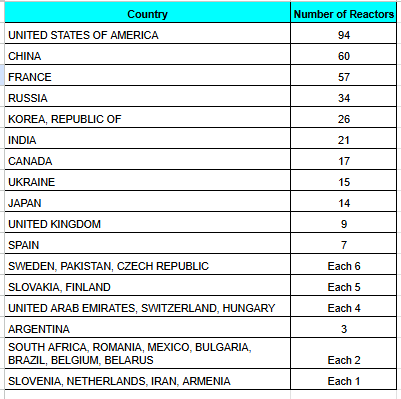
Listing of countries by number of operational nuclear reactors
Below is the listing of the number of nuclear operational reactors by country. This data is taken from the Power Reactor Information Systems (PRIS) database available on the International Atomic Energy Agency (IAEA) website.
As per this listing, the USA has the highest number of reactors followed by China, France and other countries. France gets two-thirds of its electricity from nuclear power plants
Conclusion
Uranium undergoes nuclear fission chain reaction releasing huge amounts of energy of the order of 108-1010 KJmol-1. This is million times more than the amount of energy released from sources that undergo chemical reactions. The theoretical amount of electricity that can be generated from 1kg of Uranium ore enriched to 3% U235 is calculated as 132,150 Kwh and 68,395 kilograms of coal will be needed to generate this same amount of electricity. It appears power generation from the U is the efficient route but we have to understand and analyze the financial costs, setting up costs and efforts, efficiency and risk factors involved with nuclear reactions. Moreover, extraction, enrichment, and use of uranium are strictly regulated by national and international laws. Though this article primarily dealt with describing the power generation process, it would be interesting to do a market analysis of U resources by country to understand how countries are positioned to make use of U as a primary source of electricity generation.
While I am finishing this article, the foremost thought that is bombarding my mind is how and why is this radioactive element having such a high half-life time?
Bibliography
1. Concise Inorganic Chemistry, J.D.Lee, ELBS fifth edition,1996
2. Uranium Marketing Annual Report – https://www.eia.gov/uranium/marketing/
3. International Atomic Energy Agency (IAEA) Power Reactor Information System (PRIS) – PRIS – Reactor status reports – In Operation & Suspended Operation – By Country
Courtesy: Image by vectorjuice in magnific





Leave a Reply