

In a previous blog, I shared my thoughts and opinions about the outlook of occupations with the widespread adoption of LLMs in businesses. In this blog, I discuss a hands-on experiment I performed with LLMs in which I submitted a task appropriate for a Market Research Analyst. I then assessed the outputs based on correctness, quality, reasoning, creativity, and relevance. The assessment revealed that LLM outputs were usable in situations where it required secondary research, assimilation, synthesis and reporting whereas it was not readily usable in situations where it required performing reasoning-based calculations and generating appropriate data-based visualizations. In such cases, human expertise and analysis was required to rectify the outputs to meet the delivery criteria.
The task presented as illustration here is about generating content and outputs for inclusion in venture-capital presentations. The task is based on fictitious but real-looking data. I created two separate prompts and submitted them to ChatGPT for generating the outputs. The first prompt directed for using publicly available internet resources while the second prompt directed to use input data to perform revenue, expenses and profit/loss calculations and to generate charts/visuals based on the output data.
Prompt 1: Generating content based on publicly available data
The purpose of the first prompt was to collect, assimilate and present content in a digestible manner for VCs. The entire content was based on information available in publicly available internet sources. The prompt used is presented below:
“You are a senior Market Research professional working to secure VC funding for a start-up SaaS software business. The business has been around for 3 years and is still now funded through its bootstrapped funds. The business has developed a software product called Manufacturing Intelligence Platform (MIP) to be delivered in a SaaS model. The business has tested the product with a few customers and has matured the product. The business now is ready to scale up by reaching more customers and for which it wants to secure VC funding. Prepare a 5-6 slides pitch deck having information on SaaS Market, the need of products such as MIP in manufacturing industry, and Market players which can be used for inclusion in presentations to Venture Capitalists.“
The prompt has the required context, goal and directions to generate the output. Information about the business, product and the purpose (which is to generate content for inclusion in VC pitching decks) provides the context for the LLM to generate outputs. Further, information on what is to be included in the slide deck, approximate length of output (i.e. 5-6 slides) and approximate format of the output informs the LLM with clear directions to generate the output.
Output from LLM
The following was the output from ChatGPT. With the provided persona, context, goal and output expectations, LLM has generated content tailored to the context which can be incorporated in the pitch deck after ensuring that the information is relevant and would assimilate well with the rest of the presentation. Without providing a context, i.e. by just asking LLM to generate a pitch deck having information on SaaS Market, the need of products such as MIP in manufacturing industry, and Market players would have been too broad and generic and would not have been readily usable for presentations. Below was the output generated:
Slide 1: Market Opportunity – Global SaaS Growth
Title: Massive & Expanding SaaS Market
- Global SaaS market valued at $399B (2024) → projected $819B by 2030 (12% CAGR)
- Long-term projections exceed $1T+ market size, driven by cloud and AI adoption
- North America leads with ~43% market share, strong enterprise adoption
Key Drivers:
- Shift from on-premise → cloud-based solutions
- Demand for scalability, cost efficiency, and remote accessibility
- Rapid adoption of AI-powered analytics and automation
Investor Takeaway:
SaaS remains one of the fastest-growing, high-multiple sectors, with strong recurring revenue models.
Slide 2: Manufacturing SaaS – High-Growth Vertical
Title: Manufacturing SaaS: A $70B+ Opportunity
- Manufacturing SaaS market:
- $33.2B (2024) → $71.4B by 2030
- CAGR: ~12.9%
Industry Trends:
- Smart factories & Industry 4.0 adoption
- Increasing demand for real-time operational intelligence
- Integration of IoT, AI, and predictive analytics
Shift Toward Vertical SaaS:
- Industry-specific SaaS growing faster than horizontal tools
- Companies prefer workflow-integrated solutions over generic platforms
Investor Takeaway:
Manufacturing is undergoing digital transformation, creating strong demand for specialized platforms like MIP.
Slide 3: Problem & Gap in Manufacturing
Title: Fragmented Data, Inefficient Decision-Making
Current Challenges in Manufacturing:
- Disconnected systems (ERP, MES, IoT, spreadsheets)
- Lack of real-time visibility across operations
- High downtime, inefficiencies, and reactive decision-making
- Limited predictive insights from existing tools
Market Gap:
- Existing solutions are:
- Too generic (horizontal SaaS)
- Too complex or legacy (ERP-heavy)
- Not analytics-first
Opportunity:
- Unified Manufacturing Intelligence Layer
- Turning raw data → actionable insights
Slide 4: Solution – Manufacturing Intelligence Platform (MIP)
Title: AI-Powered Intelligence for Smart Manufacturing
MIP Value Proposition:
- Unified platform integrating:
- ERP + MES + IoT + shop-floor data
- Real-time dashboards & analytics
- Predictive maintenance & anomaly detection
- AI-driven decision support
Key Differentiators:
- Built specifically for manufacturing workflows (Vertical SaaS)
- Faster deployment vs legacy systems
- Scalable SaaS model (subscription-based recurring revenue)
Outcome for Customers:
- Reduced downtime
- Improved productivity
- Data-driven decision-making
Slide 5: Competitive Landscape
Title: Competitive Positioning
Key Market Players:
- Large Enterprise Platforms:
- Microsoft (Azure IoT, Dynamics)
- SAP (Manufacturing Cloud)
- IBM (Maximo, AI analytics)
- Industrial & Manufacturing Specialists:
- Siemens (MindSphere)
- PTC (ThingWorx)
- Rockwell Automation
- Emerging Vertical SaaS Players:
- Tulip Interfaces
- Sight Machine
- Instrumental
Positioning of MIP:
- More agile than enterprise giants
- More integrated & scalable than niche tools
- Focus on intelligence layer vs system of record
Investor Takeaway:
Clear whitespace in mid-market manufacturing intelligence platforms
Slide 6: Why Now & Investment Rationale
Title: Timing is Perfect for Scale
Market Timing:
- Manufacturing digitization accelerating post-COVID
- AI becoming a core enterprise spending priority
- Shift toward outcome-driven SaaS solutions
Traction संकेत (Customize with your data):
- Product validated with early customers
- Proven use cases & ROI
- Scalable SaaS architecture
Growth Strategy:
- Expand into mid-to-large manufacturers
- Partnerships with system integrators
- Land-and-expand SaaS model
Investment Ask (example):
- Funding to scale:
- Sales & marketing
- Product enhancement (AI/ML)
- Geographic expansion
Closing Statement:
MIP is positioned to become the intelligence backbone of modern manufacturing
Since the context was given, LLM could understand that this is for VC funding and in every slide has included content which directly addresses the needs/expectations of a VC. Further, LLM also generated the sources/references that were used to generate this content.
Generating output based on input data containing confidential information
It is a safe practice to feed confidential information into a dedicated secured cloud-based system having the LLMs deployed on it. As this is for illustration purposes containing fictitious data, I shared in the prompt the confidential data with ChatGPT API available for free usage on the internet. Here was the prompt used:
““Prepare a Financial projection such that the business will be profitable in 1H 2028.
The template has the estimated number of customers by each period, estimated number of professionals in each role for each period and their salaries. Use the following numbers for Infrastructure and Marketing to begin with for 1H 2026 and adjust them accordingly in subsequent periods so that the business is profitable in 1H 2028.
- Hardware expense – $1,500
- Office Space & Maintenance – $1,800
- Promotion – $25,000
- Marketing expense – $25,000
Use the Excel template (MIP Financial Projection.xlsx – sheet2) to do the calculations and to arrive at the cumulative loss/profit for 1H 2028. “
The details that were included in the Excel template are:
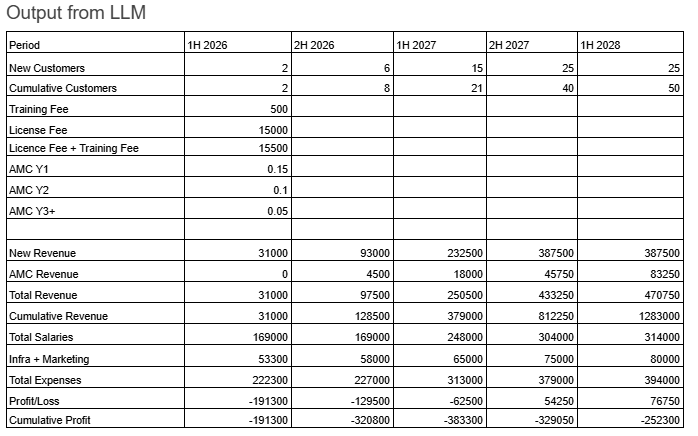
Output from LLM
Analysis of outputs
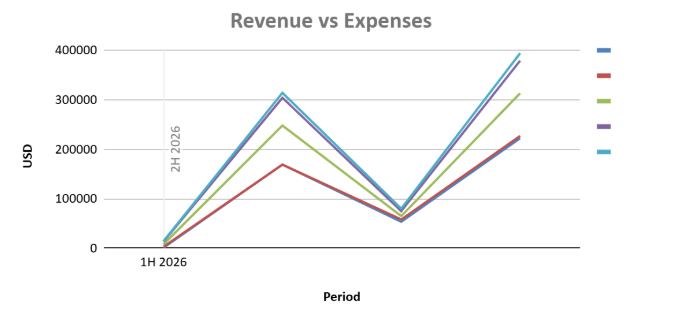
ChatGPT did simulate numbers for Infrastructure and Marketing based on optimized scaling for subsequent periods and showed profitability in 1H 2028 as requested in the prompt. Further, it also provided useful suggestions to restate Annual Licensing revenue. At first, the Annual Licencing Revenue was provided as $7,500 and the LLM model issued a warning that it is not possible to show profitability in 1H2028 with that level for Annual Licensing revenue and suggested increasing it to $15,000.
Upon reviewing the calculations and numbers from the output, it was noticed that there were errors in calculations and probable misunderstanding of the column headers.
- The LLM did a good job calculating New Revenue. However, AMC revenue calculations needed human correction.
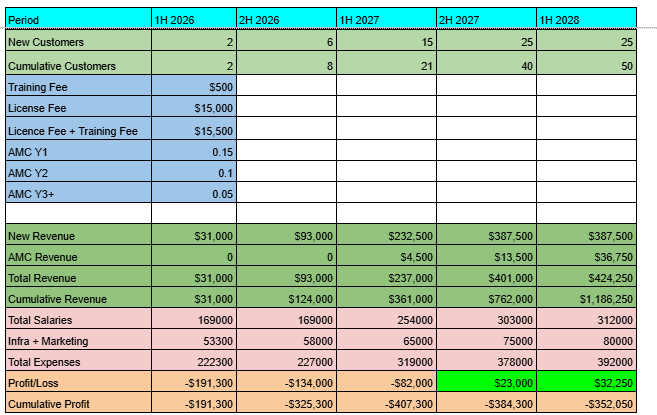
- The column headers were for half-years (semi-annual). However, for customers signed up in 1H2026, the LLM started calculating AMCs in 2H2026. Similarly for customers signed up in 2H2026, the LLM started calculating AMCs in 1H2027 and so on. As it is Annual Maintenance cost, the AMC calculations should start a year after customers sign up.
- There were double counts of AMCs. For instance, customers pay AMC once in a year. So if a 1H 2026 customer paid AMC in 1H 2027, the same customers do not have to pay AMC in 2H 2027 and they again pay only in 1H2028 and so on.
These two logical reasoning were manually corrected in the outputs. Fortunately, even after the reduction in AMC revenue after corrections, the businesses showed profitability in 1H 2028.
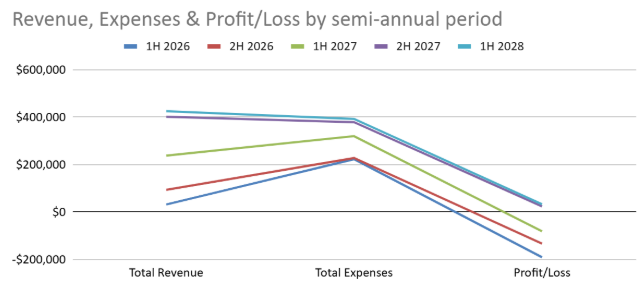
The output after manual correction was:

Discussion of outputs
- With relevant context, purpose and deliverable directions in the prompt, the LLM could get the market information using publicly available information. It also gave the sources/references (which I did not include in this blog). This saved roughly about 2 days of work. Further, the output directly addressed and included relevant content for VC deck. The following statements were relevant and seemed customized for VC decks.
- Slide 1: Investor Takeaway:
SaaS remains one of the fastest-growing, high-multiple sectors, with strong recurring revenue models. - Slide 2: Investor Takeaway:
Manufacturing is undergoing digital transformation, creating strong demand for specialized platforms like MIP. - Slide 5: Investor Takeaway:
Clear whitespace in mid-market manufacturing intelligence platforms - Slide 6: Investment Ask (example):
- Funding to scale:
- Sales & marketing
- Product enhancement (AI/ML)
- Geographic expansion
- Funding to scale:
- Closing Statement:
- MIP is positioned to become the intelligence backbone of modern manufacturing
- Slide 1: Investor Takeaway:
- LLM provided a worksheet with calculations, made good assumptions for marketing and infrastructure expenses and generated an Excel output. It gave guidance, suggestions, and options to modify numbers to meet the goal, i.e, to show profitability in 1H 2028.
- The annual salaries were given in the inputs and the LLM understood the context correctly and performed calculations for semi-annual periods by appropriately calculating half of annual salaries.
- Errors were spotted in calculations of AMC revenues which could have potentially arisen from misunderstanding of column headers and insufficient context and directions in the prompt for calculating AMCs.
- LLM did a good job by not including Training material in AMC calculations and including them only in the calculation of New Revenue.
- Charts generated by LLM to visually represent the outputs were not appropriate. Relevant charts were generated manually to effectively represent the outputs.
Conclusion
In this blog, I presented a Market Research Analyst task to ChatGPT for generating content for inclusion in Venture-capital pitching decks. The data was made fully fictitious but realistic for generating the outputs. Two prompts were given with the first prompt focused on secondary research and second prompt focused on performing calculations based on data provided to the LLM. The output from the first prompt did well on the factors namely correctness, quality, reasoning, creativity, and relevance. However, the output from the second prompt had errors in calculations, reasonings and appropriate visual creations though it did well on creativity and relevance. Probably, the second prompt should be refined further by providing more directions for performing the calculations. There was considerable time-savings with the output from the first prompt saving at least 2 days of work. Manual intervention was required for rectifying the second output. It required making correct reasonings to perform the calculations.
From the perspective of a Market Research Analyst, it will be immensely helpful to improve the quality of prompts provided to the LLM to generate readily usable outputs. Further, it is as always important to develop/improve the core analytical skills (use of appropriate metrics, research methodologies, statistical tests, and such), data collection skills, and market/business knowledge to provide effective prompts. It appears as a safe practice for analysts to perform their own calculations and computations and to verify them against the outputs from the LLMs until those outputs do not require any human reviews and rectifications.
Finally it is worth stating that for security and confidentiality reasons, confidential data (used fictitious data here though) such as those presented in this blog should be fed into secured dedicated cloud servers with LLMs deployed in it. It may be worth availing the services of vendors who provide such services.
Courtesy: <a href=”https://www.freepik.com/free-photo/admin-using-laptop-maintenance-artificial-intelligence-neural-networks_412390981.htm”>Image by DC Studio on Freepik</a>






Leave a Reply