
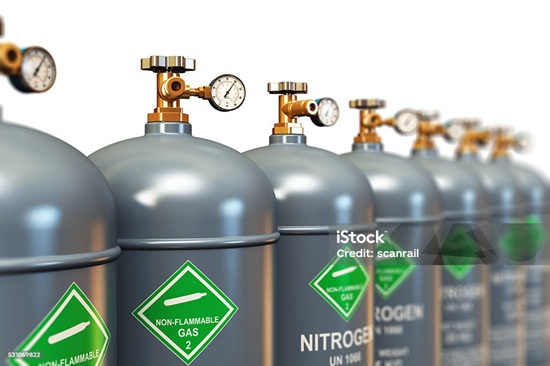
A nitrogen molecule represented as N2 exists as a gas with two nitrogen atoms bonded by three bonds between them, i.e. with a triple bond. It is the only pure element that exists bonded by a triple bond. The triple bond and resonance stabilization make Nitrogen N2 very stable at normal temperatures. 78% of the earth’s atmosphere consists of N2 molecules and it is the most abundant element in the earth’s atmosphere. Nitrogen is present in plants, animals, and humans in biomolecules such as DNA, amino acids and proteins. All living things share a special relationship with Nitrogen that lasts even after our life stops on this earth. Nitrogen is the most important element in fertilizers. These fertilizers are naturally prepared by Nature with the help of different bacteria species. However, in order to meet the demand of the growing population, man-made Nitrogen-based fertilizers are also produced on an industrial scale. Nitrogen based explosives such as Nitroglycerin, and TNT are also produced on an industrial scale. Here, in this blog I discuss the role of N2 in this earth, and the properties of Nitrogen that makes it useful for its applications. I try not to delve much into scientific aspects and thereby make this blog comprehensible for all readers regardless of their background in Science.
Nitrogen exists as a gas in the form of Nitrogen molecules. Its molecular formula is N2. The atomic number of Nitrogen is 7 and atomic mass is 14.0067 g/mol. It has 5 valence electrons and different compounds are formed depending upon the number of valence electrons that take part in forming the bond. Nitrogen atoms are strongly bonded by a triple bond making the Nitrogen molecule an extremely stable molecule. The dissociation energy for the bond is very high at 945.4 KJmol_1. This makes Nitrogen inert at room temperature. Separating (or Fixing) Nitrogen from the strong Nitrogen molecule needs extra efforts and I will briefly discuss this in the Nitrogen cycle. Further, I will briefly discuss Nitrogen explosives. Nitrogen is stable and inert at room temperature. However, when the temperature is raised, Nitrogen containing explosives explode with the release of N2 gas and other gases at high temperature.
Production of Nitrogen
Nitrogen is obtained by liquefying air. 78% by volume of air is N2. The boiling point of N2(g) is -195.8 ℃. The abundance of different gas in dry air is:
| Element | % by volume | Boiling point of gas (℃) |
| N2 (Nitrogen) | 78.08 | -195.8 |
| O2 (Oxygen) | 20.95 | -183.1 |
| Ar (Argon) | 0.934 | -186.0 |
| CO2 (Carbon-di-oxide) | 0.025 – 0.050 | -78.4 (doesn’t liquefy. Sublimes and converts to gas) |
| Ne (Neon) | 0.0015 | -246.9 |
| H2 (Hydrogen) | 0.0010 | -253.0 |
| He (Helium) | 0.00052 | -269.0 |
| Kr (Krypton) | 0.00011 | -153.8 |
| Xe (Xenon) | 0.0000087 | -108.1 |
Nitrogen with its high percentage by volume and low boiling point gets separated first from the mixture. The separated gas is stored as liquid Nitrogen in cylinders.
Nitrogen Fixation, Nitrogen Cycle and Industrial Production of Ammonia
We have seen that Nitrogen exists as a strong triple bonded Nitrogen molecule. Nitrogen in this form is unusable and is inert (i.e. it does not react). Nitrogen fixation is the process by which Nitrogen is separated and fixed in the soil from inert Nitrogen molecules present in the atmosphere. The separated Nitrogen is highly active and it combines with Hydrogen or Oxygen to form various compounds of Nitrogen hydrides (i.e. compounds having Nitrogen and Hydrogen) or Nitrogen Oxides (i.e. compounds having Nitrogen and Oxygen) which serve as fertilizers for the plants to grow and provide food to all species in this earth. Separating Nitrogen from Nitrogen molecules is a high energy process as can be guessed from the high dissociation energy of 945 KJmol-1 for N2 molecules. Nature does it effortlessly at room temperature and atmospheric pressure through various bacteria species.
It is intriguing to know that Nature accounts for every Nitrogen that is separated from atmospheric Nitrogen molecules. After Nitrogen is used by various plants and animals for their growth and survival, Nitrogen is given back to the atmosphere once the plants decompose or animals die or humans die. Nitrogen cycle describes the entire usage map of Nitrogen starting from its separation from atmospheric Nitrogen molecules to the formation of various compounds of Nitrogen (which serve as fertilizers) to the decomposition of Nitrogen from those various compounds (upon death of living species) and finally the joining of the freed Nitrogen back with the atmospheric Nitrogen molecules. Nitrogen cycle is a natural process that is carried out by bacteria species effortlessly at room temperature and atmospheric pressure.
Nitrogen cycle
The following is a schematic representation of the Nitrogen cycle:
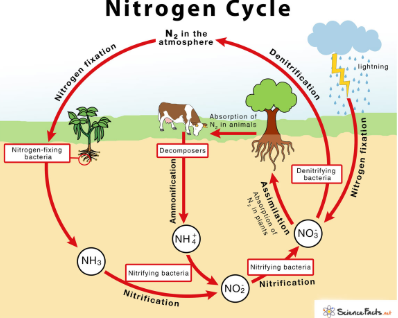
Image source: https://www.sciencefacts.net/nitrogen-cycle.html
There are several steps in the Nitrogen cycle. Each of the steps is carried out by each type of bacteria species. A brief overview of the cycle is:
- Step 1 – Nitrogen fixation: In this step, Nitrogen N is separated from Nitrogen molecules N2 present in the atmosphere. This is done by some Nitrogen-fixing bacteria. Ammonia NH3 is formed from this step. Ammonia has a strong bad odor.
- Step 2 – Nitrification I: In this step, Nitrifying bacteria convert Ammonia into Nitrite compounds, i.e. compounds containing 1 Nitrogen and 2 Oxygen accompanied by release of energy
- Step 3 – Nitrification II: In this step, Nitrifying bacteria convert Nitrites to Nitrates, i.e. compounds containing 1 Nitrogen and 3 Oxygen. The formation of Nitrates are essential as they are the natural fertilizers. Nitrates are the building blocks for synthesis of biomolecules such as amino acids, proteins, and chlorophyll molecules. These biomolecules again are the building blocks of living beings.
- Step 4 – Assimilation: The Nitrates formed in the previous step are readily soluble in water. But still, they are not yet in a form that is usable by plants. Assimilation is a process by which the bacteria make nitrates usable by plants. Amino acids, proteins, and chlorophyll biomolecules are formed from Nitrates. Plants take these biomolecules and the plant grows yielding food. These foods are then taken by animals and human beings for their growth and survival.
- Step 5 – Ammonification: This is the initiation of Nature’s recycling step for Nitrogen. When the plants decompose, the Nitrogen is extracted and converted to Ammonium ions (NH4+ ions) by another group of decomposers bacteria species. These ions again form Nitrites and Nitrates and go through the Assimilation steps. Every time Nitrogen goes through these series of cyclical steps, the soil gets more and more fertile helping the growth of plants, animals, humans, and all living forms.
- Step 6 – Denitrification: Once there is no need for those Nitrite and Nitrate molecules (which could occur when there are no plants or when living forms die), denitrification bacteria extracts Nitrogen and puts them back into the atmosphere as N2 molecules.
Physical method of Nitrogen Fixation
Apart from the above natural fixing process of Nitrogen by bacteria through the Nitrogen cycle, Lightning also helps to fix Nitrogen in the soil. Lightning raises the temperature, breaks atmospheric Nitrogen molecules into Nitrogen atoms and through a series of chemical steps, the extracted Nitrogen combines with oxygen to form Nitrate compounds. The Nitrate compounds reach the soil, and they are made usable for plants. Thus, every time Lightning occurs, the soil gets more fertile as more and more Nitrate compounds reach the soil.
Industrial production of Nitrogen and Fertilizers
The above two routes, Nitrogen cycle and Lightning, are natural processes for fixing Nitrogen and forming Nitrate fertilizers. Apart from these two routes, there is also a man-made Industrial process for fixing Nitrogen and producing Nitrate fertilizers. This process is called the Haber Bosch Process. This process was discovered in the early 20th century. This industrial process produces Ammonia NH3 from atmospheric Nitrogen molecules. From the Ammonia NH3 produced, man-made Nitrogen fertilizers such as Urea and Ammonium Nitrate are produced for agricultural purposes. The invention of this industrial process allowed production of fertilizers in massive quantities. Though the drawback from using such fertilizers is that such nitrates do not decompose well and are in the danger of mixing with water bodies which could harm the environment and species living in the water.
Le Chateliers Principle and Haber Bosch Process
Before giving an overview of the Haber Bosch process, it is worthwhile to go through a simple and intuitive chemistry concept called Le Chatelier’s Principle. This principle qualitatively describes the effect of external factors that are applied to a chemical system while the system is at chemical equilibrium. Chemical equilibrium occurs in a reversible system where the rate of forward reaction is equal to the rate of the backward reaction thereby making the system appear static or as normal as it could be. This principle is applicable only when systems are at a chemical equilibrium.
We witness equilibrium in other instances too in our day-to-day life. One instance is Market equilibrium. At Market equilibrium, the flow of demand and supply are natural without any external influences. Natural flow of demand and supply decides the prices for the products. Another instance is Economic equilibrium. At Economic equilibrium, there are normal cycles of inflation and deflation which guides people’s spending/saving behavior.
Such equilibria are disturbed or modified when external forces have to take control of the system to meet certain objectives or goals. When the flow of demand and supply is disturbed, the market equilibrium is affected and the prices swing artificially. For e.g., demand is increased to increase prices, supply is increased to reduce prices, and such. Similarly to affect the economic equilibrium, interest rates are altered to increase or decrease the flow of money in the economy. Increase in interest rates will make people borrow less which in turn will decrease flow of money in the economy leading to deflation and less spending in the economy and vice-versa.
Similarly such external disturbances can also be effected in a chemical system at equilibrium to shift the system in the desired direction. The external factors are applied as changes in Pressure (or volume), temperature, and/or concentration of reactants and products. By forcing changes in one or more of these external factors, the forward or backward reaction can be favored for a while before the system finds a new equilibrium. Le Chatelier’s Principle states that the system will respond to those external factors in such a way as to minimize their effect by either favoring the forward reaction or reverse reaction.
Let us apply Le Chateliers Principle for the reversible reaction involving synthesis of Ammonia. Ammonia is synthesized by the Haber Bosch process on an industrial scale. The reaction is:
N2(g) + 3H2(g) ⇌ 2NH3(g) + heat
The reaction is one unit(mole) of Nitrogen gas reacting with 3 units(moles) of hydrogen to give 2 units (moles) of Ammonia as the product along with release of energy. As evident from the reaction, there are 4 moles of reactants and 2 moles of product, i.e. there are more reactants than products. To get desirable quantities of Ammonia, external factors of Volume, temperature and pressure have to be applied at equilibrium in such a way as to make the chemical system move to the right hand side direction,i.e. to favor forward reaction.
In the Haber Bosch process, atmospheric Nitrogen is produced by liquefaction of air. This atmospheric nitrogen is made to react with Hydrogen (which is produced from methane or electrolysis of water – I had discussed about production of hydrogen gas in my previous article on hydrogen – Hydrogen – the element with the simplest structure & least mass and the most abundant element in the universe – Foxtail Research. The ammonia then produced is continuously removed and is stored as liquid ammonia in cylinders. Synthetic fertilizers such as urea, ammonium nitrate, ammonium sulphate are then manufactured from the liquid ammonia.
The following table summarizes the effects of enforcing external pressure, concentration and/or temperature changes at equilibrium for the above ammonia synthesis chemical reaction.
(1) Changing concentration of reactants or products
| External factor | Favored direction of reaction | Effect on chemical system |
| Add Nitrogen (i.e. increase Nitrogen concentration) | Forward reaction (System tries to reduce Nitrogen) | System moves right |
| Add Hydrogen (i.e. increase Hydrogen concentration) | Forward reaction (System tries to reduce hydrogen) | System moves right |
| Add Ammonia (i.e. increase Ammonia concentration) | Reverse reaction ( (System tries to reduce ammonia) | System moves left |
| Remove Nitrogen (i.e. decrease Nitrogen concentration) | Reverse reaction (System tries to increase Nitrogen) | System moves left |
| Remove Hydrogen (i.e. decrease Hydrogen concentration) | Reverse reaction (System tries to increase hydrogen) | System moves left |
| Remove Ammonia (i.e. decrease Ammonia concentration) | Forward reaction (System tries to increase ammonia) | System moves right |
(2) Changing pressure applied on the system
| External factor | Favored direction of reaction | Effect on chemical system |
| Increase Volume or decrease pressure | Reverse reaction (System shifts which has more moles of gas) | System moves left |
| Decrease volume or increase pressure | Forward reaction (System shifts which has less moles of gas) | System moves right |
(3) Changing Temperature of the system
| External factor | Favored direction of reaction | Effect on chemical system |
| Increase Temperature (i.e. add heat) | Reverse reaction (System tries to reduce heat) | System moves left |
| Decrease Temperature (i.e. remove heat) | Forward reaction (System tries to increase heat) | System moves right |
From the above tables, we can deduce that in order to increase the output of ammonia, it is required to: (i) Add Nitrogen gas (ii) Add Hydrogen gas (iii) Remove Ammonia gas as and when formed (iv) Increase pressure (v) Decrease temperature. The Haber Bosch process is carried out at 200-300 atmosphere pressure and 400-500 degree celsius. Further, Iron is used as a catalyst for the reaction. To avoid reverse reaction, Ammonia is cooled and collected as and when formed. Liquid ammonia produced is then used to manufacture fertilizers such as urea, ammonium nitrate, and ammonium sulphate.
Industrial production of ammonia is an expensive process unlike the natural process where bacteria seamlessly generate nitrate fertilizers at normal temperature and atmospheric pressure conditions.
Manufacture of Explosives
We have seen that Nitrogen molecules are extremely stable and inert. This property comes in handy for use in explosives. When a Nitrogen molecule is formed from igniting reactants, a large amount of energy is released. This large increase in energy is in the form of heat triggers explosion.
Let us discuss this with Nitrogen-containing compounds TNT (trinitrotoluene) and Nitroglycerin. These compounds are produced on an industrial scale, primarily for use in mining, construction, and military applications. These compounds when mixed with heat in a restricted space undergo rapid and violent reactions and release large amounts of energy and gaseous products. As they are in a restricted space, there is not enough space for the products to be confined. Therefore, out of huge pressure, temperature and space restrictions, they explode causing huge explosions.
The following reaction is the explosive decomposition of TNT or TriNitroToluene. The reaction produces 20 moles of gaseous products (10 times) from 2 moles of TNT. Along with these gaseous products, a large amount of energy is released in the form of heat.
2C7H5N3O6(s) -> 12CO(g) + 5H2(g) + 3N2(g) + 2C(s) + energy
The release of Nitrogen molecules results in the release of a huge amount of energy in the form of heat.
The following reaction is the explosive decomposition of Nitroglycerin. The reaction produces 29 moles of gaseous products (7 times) from 4 moles of nitroglycerin. Along with these gaseous products, a large amount of energy is released in the form of heat.
4C3H5N3O9(l) -> 6N2(g) + 12CO2(g) + 10H2O(g) + O2(g) + energy
The release of Nitrogen molecules results in the release of a huge amount of energy in the form of heat.
Summary
In this article, I have discussed (i) General properties of Nitrogen, Nitrogen cycle, natural production of Nitrogen fertilizers through Nitrogen cycle, physical production of Nitrogen fertilizers from lightning, and industrial production through Haber Process, (ii) Steps involved in the Nitrogen cycle, (iii) Haber Bosch process, the conditions applied to produce Ammonia in this industrial process and the concept and application of Le Chateliers principle, and (iv) the use of Nitrogen containing compounds as explosives.
Nitrogen plays such an important role for the sustenance of life on this earth. Nitrogen exists as inert and extremely stable Nitrogen molecules N2 in the atmosphere. Nitrogen is unusable in its inert form. To make it usable and to make fertilizers, i.e. nitrate compounds for plants, Nature goes through the Nitrogen cycle. In this cycle, Nature with the help of various species of bacteria, extracts or fixes Nitrogen from atmospheric nitrogen molecules and converts them to ammonia and then to nitrates. These nitrates are then used by plants for its growth. These plants are then consumed by other living forms such as animals and humans for survival and sustenance. When plants decompose, the nitrates are returned to the soil for use by other plants. When humans or animals die, nitrogen is extracted from nitrates and returned to the atmosphere as atmospheric nitrogen. Thus Nature has designed a highly efficient Nitrogen recycling system where every Nitrogen consumed is accounted for and returned back to its original place.
Fertility of the soil increases every time NItrates are used by plants and returned to the soil. Thus it is important to plant trees and protect the fertility of soil.
Bibliography
1. Concise Inorganic Chemistry, J.D.Lee, Fifth Edition, Educational Low-Priced Books Scheme (ELBS) funded by the British Government
2. Chemistry, Steven S. Zumdahl, Second Edition, D. C. Heath and Company
Image courtesy: https://media.istockphoto.com/id/531069822/photo/row-of-liquefied-nitrogen-industrial-gas-containers.jpg?s=1024×1024&w=is&k=20&c=ZG6upzyUdG1BVMsPT-6eI5s3Esc-V8wr3RcIhEd1_cQ=


Leave a Reply